In This Article
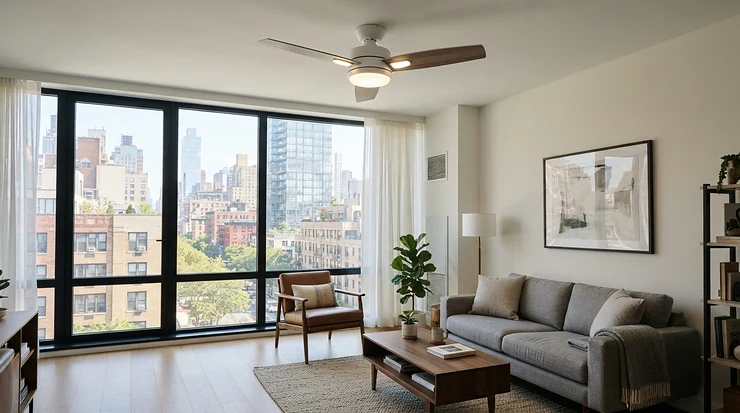
Eight feet of ceiling sounds generous until you hang a spinning object from it. Then the math gets rude. A standard fan with a downrod can leave blade tips hovering right around forehead height, and anyone over six feet tall learns that lesson once. The fix is a low profile ceiling fan with light for 8 foot ceilings: a fixture that snuggles up to the ceiling, spins safely overhead, and doubles as your room’s lighting. 🚴♂️💡

This guide cuts through the marketing. We researched seven real fans across budget, mid-range, and premium tiers, then interpreted their numbers for the way people actually live in low-ceilinged rooms: small bedrooms, older bungalows, condos, and apartments. You’ll see what a spec means in practice, which fans suit which rooms, and where the traps hide. Spoiler: the traps are mostly about inches. 📏
A note on method. Everything below is analysis built on published specs, retailer listings, and aggregated review sentiment. It is not hands-on testing, and wherever a data point couldn’t be verified, we say so. Prices appear as ranges only, so check current pricing before you buy.
By the end, you’ll know how to read ceiling clearance height, choose the right blade span, understand why downrod length is usually “none” on an 8-foot ceiling, and match a fan to your room without guessing.
Quick Comparison: The 7 Fans at a Glance
Here’s the whole lineup in one scannable view before we dig into each fan.
| Fan | Blade Span | Standout | Price Range (check current price) | Best For |
|---|---|---|---|---|
| Hunter Dempsey | 44″ / 52″ | Benchmark flush mount, strong airflow | Around $200-$270 | Living rooms and master bedrooms |
| DREO 44″ Low Profile | 44″ | Very quiet DC motor, smart controls | Typically mid-range | Light sleepers, tech-friendly homes |
| Amico 42″ Low Profile | 42″ | DC motor, dimmable light | Typically budget to mid-range | Small bedrooms on a budget |
| Hunter Builder 42″ | 42″ | Name-brand simplicity | Typically mid-range | Rental-friendly upgrades |
| Hampton Bay Sidlow 52″ | 52″ | Five reversible blades, big-box support | Typically mid-range | Larger rooms with an 8-foot ceiling |
| Modern Forms Axis 44″ | 44″ | Premium smart fan, wet-rated | Around $500 | Design-first buyers |
| Mainstays 42″ Hugger | 42″ | Cheapest way to move air | Roughly $40-$80 | Guest rooms, tight budgets |
Look at the table with a decision-maker’s eye. The Hunter Dempsey and the Modern Forms Axis sit at the premium end, but only the Hunter Dempsey pairs strong airflow with a known flush-mount drop. The Mainstays 42″ Hugger and Amico 42″ Low Profile prove you can get a ceiling-hugging fan with a light for very little. The Hampton Bay Sidlow 52″ is the pick when the room is bigger than the ceiling is tall.
💬 Just one click — help others make better buying decisions too!😊
What Is a Low Profile Ceiling Fan With Light for 8 Foot Ceilings?
A low profile ceiling fan with light for 8 foot ceilings is a flush-mount, or “hugger,” fan that attaches directly to the ceiling with no downrod and keeps its total drop to roughly 9-11 inches. It combines airflow and illumination in one fixture so blades stay a safe height above your head, typically 7 feet or more from the floor.
That definition matters because “low profile” gets stretched in marketing copy. Real flush-mount models in our research listed drops from about 9.2 to 10.6 inches. Anything dangling beyond a foot is not truly a hugger.
The trade-off is physics. According to ENERGY STAR’s ceiling fan guidance, fans should hang at least 7 feet above the floor and ideally 8-9 feet, which an 8-foot ceiling can’t deliver. So the design goal here isn’t ideal airflow. It’s the best airflow possible while staying safe. That’s why blade pitch, motor type, and blade span matter more on a hugger than on a standard fan.
Top 7 Low Profile Ceiling Fans With Light for 8 Foot Ceilings: Expert Analysis
1. Hunter Dempsey Low Profile with Light — the benchmark for 8-foot rooms
The Hunter Dempsey wins fans by doing the unglamorous thing well: staying out of your way. One roundup measured it at about 9.4 inches from the ceiling, which is why it keeps appearing on shortlists for rooms where a downrod fan would force you to duck.
On a 96-inch ceiling, that 9.4-inch drop puts the underside around 86.6 inches off the floor. That’s roughly 7 feet 2½ inches, comfortably above the 7-foot guideline but not by a mile. The 52-inch version was listed at about 4,900 CFM in one comparison, serious airflow for a hugger, and Hunter pairs it with its quiet-motor positioning.
Who’s it for? A living room or master bedroom in the 144-225 square foot range, where the 52-inch span earns its keep. Hunter’s own site shows ratings around 4 out of 5 across roughly 78 reviews for the 44-inch and 120 for the 52-inch. That’s brand-site data, not independent testing, so weigh it accordingly.
Pros:
- ✅ Roughly 9.4-inch drop suits 8-foot ceilings
- ✅ Strong listed airflow for a flush mount
- ✅ Available in 44-inch and 52-inch spans
Cons:
- ❌ Costs more than basic big-box huggers
- ❌ 52-inch span is overkill for tiny rooms
Expect roughly $200-$270 depending on size and finish. The value verdict: worth it if the fan will be your main airflow source, less so for a spare room.

2. DREO 44″ Low Profile Ceiling Fan with Light — whisper-quiet DC motor
The DREO 44″ Low Profile is the fan for people who hear everything. It uses a reversible DC motor with six speeds, and the listing advertises about 22 dB at its quietest setting. Treat that as a low-speed best case, since real-world noise rises as you speed up.
The total profile runs just over 9.5 inches from ceiling to blade, and the listing mentions a 14° blade angle. Translation: steeper pitch moves more air per rotation, which helps a compact fan punch above its span. A 44-inch span fits bedrooms in roughly the 100-144 square foot range, where a 52-inch fan would crowd the walls. DC motors also draw less power and allow finer speed steps than most AC budget motors.
The five-color-temperature light is the other draw, letting you shift from candle-warm to daylight white. One roundup scored the DREO around 4.5 stars. A caution: a roundup of the larger 52-inch smart model noted that Alexa commands can occasionally confuse the fan with the light, so test voice routines after setup.
Pros:
- ✅ Very quiet DC motor at low speeds
- ✅ Five adjustable light color temperatures
- ✅ Compact 44-inch span suits bedrooms
Cons:
- ❌ No pull chain, so you depend on remote or app
- ❌ Smart features add setup steps
Pricing sits in the mid-range tier, so check current price. Verdict: strong value for bedrooms.
3. Amico 42″ Low Profile Ceiling Fan with Light — budget DC motor with dimmable light
The Amico 42″ Low Profile is the budget pick that refuses to feel budget. Several roundups praise it for 8-foot rooms, and the headline specs are a DC motor, a dimmable three-color-temperature light, and a listed noise level around 35 dB.
That 35 dB figure is quiet-library territory on paper, though it’s a manufacturer-style claim like most. The 42-inch span is the real story: it suits a small bedroom or office, where a huge blade sweep would feel like a helicopter in a closet. The three-tone light is more useful than it sounds, because warm white for winding down and cooler white for morning routines is a real lifestyle upgrade.
Reviews are the honest gap. One roundup says two issues recur in owner feedback, but we couldn’t verify what they are. The practical move is to sort retailer reviews by three stars before buying and look for patterns in noise or remote reliability.
Pros:
- ✅ DC motor at a budget-friendly tier
- ✅ Three-color-temperature dimmable light
- ✅ Compact span fits small rooms
Cons:
- ❌ Brand track record is thinner than Hunter’s
- ❌ Limited airflow for rooms over about 150 square feet
Expect budget to mid-range pricing, so check current price. Verdict: excellent value for a small bedroom.
4. Hunter Builder 42″ Low Profile with LED — no-fuss name-brand hugger
The Hunter Builder 42″ is the safe middle road. Roundups position it for ceilings under 9 feet, and it comes with an LED light and a range of finishes, including a bronze that suits traditional décor.
Builder-grade sounds like an insult, but it’s often a compliment. It means the fan is designed for easy installation, broad compatibility, and predictable behavior rather than flashy extras. The 42-inch span handles roughly the same rooms as the Amico 42″ Low Profile, so the decision comes down to brand comfort, finish options, and warranty terms, which are worth confirming on the current listing.
One roundup flags it as top rated for the category, though we couldn’t verify the underlying review counts. The honest takeaway: it’s a conservative, well-known choice for buyers who’d rather pay a little more for a recognizable name and easier customer support.
Pros:
- ✅ Recognizable brand with accessible support
- ✅ Designed for ceilings under 9 feet
- ✅ Multiple finishes for different décor
Cons:
- ❌ Fewer premium features than DC-motor rivals
- ❌ Costs more than the Mainstays 42″ Hugger
Pricing sits in the mid-range, so check current price. Verdict: sensible for rentals and guest rooms.
5. Hampton Bay Sidlow 52″ Hugger with Light — big-box convenience, five reversible blades
The Hampton Bay Sidlow 52″ is for people who want to walk into a store, pick a box, and go home. It’s a dry-rated, five-blade hugger with a quick-install design and an LED light kit.
The reversible blades matter more than they sound. Flip them and you change the finish from one tone to another, which helps match shifting décor. The 52-inch span suits larger bedrooms or living rooms, and it’s the widest fan on this list besides the Hunter Dempsey.
The Home Depot page showed nearly 500 reviews at the time of research, along with dozens of answered questions, which suggests an active owner community. We couldn’t verify the average star rating, so read the most recent reviews directly. “Dry rated” also means indoor use only, so skip it for covered porches.
Pros:
- ✅ Wide 52-inch span for larger rooms
- ✅ Quick-install design simplifies setup
- ✅ Reversible blades flex with décor
Cons:
- ❌ Not suited for damp or covered outdoor spaces
- ❌ Fewer smart features than DREO 44″ Low Profile
Expect mid-range pricing, so check current price. Verdict: great value for bigger rooms.
6. Modern Forms Axis 44″ Smart Fan — premium compact smart fan
The Modern Forms Axis 44″ is the design-forward splurge. Roundups describe it as a compact smart fan with app control, a wet rating, and about 4,400 CFM, and it sits around $500.
That CFM is impressive for a 44-inch fan, which suggests an engineered blade and motor rather than a commodity design. The wet rating is a bonus if your 8-foot ceiling includes a covered patio or humid bathroom-adjacent space. The caution is mounting: we couldn’t verify the exact total drop in our sources, so confirm the ceiling-to-blade measurement on the spec sheet before buying for an 8-foot room.
No independent review sentiment was verifiable in our research, so this pick is spec-led rather than review-led. Buy it if aesthetics and app control matter, and double-check the clearance math first.
Pros:
- ✅ High listed airflow for a 44-inch span
- ✅ App control and smart features
- ✅ Wet rating adds placement flexibility
Cons:
- ❌ Premium price for a compact fan
- ❌ Total drop needs verification before purchase
Expect around $500. Verdict: worth it only if design and smart features are priorities.
7. Mainstays 42″ Hugger Indoor Fan with Light Kit — cheapest way to get airflow overhead
The Mainstays 42″ Hugger is proof that a low ceiling doesn’t require a big budget. It’s a four-blade, reversible-airflow hugger with a light kit, and Walmart’s listings show prices roughly in the $40-$80 range depending on finish.
At this price, expectations should be modest. Budget AC-motor fans tend to be louder and to offer fewer speed steps than DC designs, and complaints about humming on cheap huggers are common across the category. The upside is simplicity: one switch, one light, and a 42-inch span that suits a guest room or small office.
Retail listings showed review counts in the thousands for the 42-inch family, with ratings in the mid-4s at the time of research, though the exact figures vary by finish. Skim the three-star reviews to see if noise complaints match your tolerance.
Pros:
- ✅ Lowest price on this entire list
- ✅ Light kit and reverse airflow included
- ✅ Huge pool of owner reviews
Cons:
- ❌ Budget motors can be noisier than DC rivals
- ❌ Basic light and controls
Expect roughly $40-$80. Verdict: unbeatable value for a guest room.
✨ Don’t Miss These Exclusive Deals!
🔍 Take your 8-foot-ceiling comfort to the next level with these carefully selected fans. Click on any highlighted product name to check current pricing and availability. A well-chosen low profile ceiling fan with light for 8 foot ceilings will make every room feel cooler, brighter, and safer! 😊
Ceiling Clearance Height: The Math That Keeps You Safe
Ceiling clearance height is the single number that decides whether a fan is a gift or a hazard. Start with your actual ceiling: an “8-foot” ceiling is usually 96 inches, but old houses can be shorter. Subtract the fan’s listed drop, and that’s your floor-to-blade-bottom distance.
The widely used benchmark is 7 feet, or 84 inches. Fine Homebuilding notes that it couldn’t find a specific code reference for a minimum height, but online sources consistently recommend at least 7 feet. Manufacturer instructions typically specify the same 7-foot minimum, and inspectors often enforce it. Here’s the practical consequence: a 96-inch ceiling minus a 10-inch drop leaves about 86 inches, which clears the 84-inch mark by roughly 2 inches.
Two details trip people up. First, check whether a listed drop is measured to the blade or to the bottom of the light kit, since those can differ. Second, factor in blade wobble and door swing, which is why many inspectors prefer a few extra inches. If your ceiling is shorter than 96 inches, run the math before ordering. A fan that clears on paper at 7 feet 2 inches can feel uncomfortably low for a tall household.

Blade Span: Matching Fan Size to Your Room
Blade span is the diameter of the circle your blades sweep, and it’s the most misunderstood number on a spec sheet. Bigger isn’t always better, especially on a hugger, because blades sit close to the ceiling and push air sideways instead of downward.
| Room Size (sq ft) | Common Blade Span | Best For |
|---|---|---|
| Up to 75 | 29-36″ | Closets, tiny offices |
| 75-144 | 36-44″ | Small bedrooms, nooks |
| 144-225 | 44-52″ | Master bedrooms, small living rooms |
| 225-400 | 52-60″ | Large bedrooms, living rooms |
These are widely cited rule-of-thumb ranges, not laws. Read the table as a starting point. A 12-by-12 bedroom, at 144 square feet, sits right on the line between a 44-inch and a 52-inch fan, so ceiling height and furniture tip the decision. On an 8-foot ceiling, many buyers prefer the smaller option because a huge blade span feels more intrusive when it’s only 7 feet off the floor.
One more trick: PNNL’s Building America Solution Center advises measuring the room and choosing an appropriately sized fan. Keep blades at least 18 inches from walls, a rule that quietly eliminates oversized fans in narrow rooms.
Downrod Length: Why 8-Foot Ceilings Usually Mean Zero
Downrod length is the pole between the motor and the ceiling mount, and on an 8-foot ceiling the right answer is typically none. Common sizing charts list “no downrod” for 8-foot ceilings and start adding length at 9 feet, with roughly 6 inches for a 9-foot ceiling and about 12 inches for 10 feet.
The standard formula is ceiling height, minus the fan’s own height, minus your desired hanging height of about 8 feet. On an 8-foot ceiling that equation goes negative, which is the math’s way of saying “hug the ceiling.”
There’s a nuance worth knowing. Some dual-mount fans include a short rod or a flush adapter, so you can switch later if you move to a taller room. One research source noted that a 4-inch downrod included with a smart fan helps fine-tune the drop for very low ceilings, though on a true 8-foot ceiling you’d generally skip it. If you adore a fan that normally ships with a rod, check whether a flush-mount adapter exists. Never improvise one.
Also remember that a light kit adds height. State guidance from Hawaii’s energy office advises shortening a downrod by 12 inches when a light kit is attached, which is a useful reminder that lights consume vertical space too.
Hugger Ceiling Fan With Light for Low Ceilings: How It Compares to Other Mounts
A hugger ceiling fan with light for low ceilings gives up some airflow in exchange for headroom. ENERGY STAR notes that huggers move less air than regular fans because the blades sit closer to the ceiling, but in a room with a low ceiling the alternative is often no fan at all.
| Mount Type | Typical Drop | Airflow | 8-Foot Suitability | Best For |
|---|---|---|---|---|
| Hugger / flush mount | About 9-11″ | Moderate | Excellent | 8-foot rooms, bedrooms |
| Standard downrod | Often well over 12″ | Strong | Poor | 9-foot ceilings and higher |
| Dual-mount | Varies by mount | Varies | Good when used flush | Rooms you might change later |
Notice what the table implies. A hugger like the Hunter Dempsey or Hampton Bay Sidlow 52″ trades some air movement for safe clearance, and the fix is usually blade pitch and span rather than a longer rod. One review source observed that a 44-inch hugger can feel just as effective as a 52-inch fan on a standard mount because air feels more direct near the blades.
The takeaway: on an 8-foot ceiling, don’t mourn the airflow you can’t have. Pick the highest-pitched, best-engineered hugger your budget allows.
Flush Mount Ceiling Fan With Light for Small Bedroom: What to Prioritize
A flush mount ceiling fan with light for small bedroom use has a different job than a living-room fan. It needs to be quiet, dimmable, and unobtrusive, because you’ll hear it, see it, and sleep under it every night.
Start with noise. A DC motor, like the one in the DREO 44″ Low Profile or Amico 42″ Low Profile, is the safest bet for a bedroom, since these motors generally run more quietly and offer finer speed control. Next, look for a dimmable light with adjustable color temperature, because a harsh daylight bulb at 11 p.m. defeats the purpose.
Then think about controls. Huggers typically skip pull chains to keep the profile low, so a remote or app is nearly mandatory. Put the remote in a drawer you can find in the dark.
Finally, size honestly. For a bedroom of roughly 100-144 square feet, a 42-inch or 44-inch span is plenty. Going bigger can make the room feel like a fan with a bed attached. If you’re torn between a budget pick and a smarter one, remember the bedroom rule: spend on motor quality before spending on features.
How to Choose a Low Profile Ceiling Fan With Light for 8 Foot Ceilings
Follow these six steps to narrow the field fast:
- Measure your true ceiling height. Use a tape measure rather than assuming 96 inches, since older homes vary.
- Check the listed drop. Subtract it from your ceiling height and confirm you land at or above 7 feet to the blade.
- Match blade span to square footage. Use the earlier table, and lean smaller for small bedrooms.
- Choose a motor type. DC motors cost more but run quieter and offer finer control.
- Evaluate the light. Look for dimmable LED with adjustable color temperature, and check whether the bulbs are replaceable.
- Confirm controls and compatibility. Make sure the remote or app suits your habits, and verify you have a fan-rated electrical box.
Each step prevents a specific regret. Skipping step two creates a clearance problem. Skipping step four buys you a hum you’ll hear every night. Skipping step six means a return trip to the hardware store.
✨ Ready to Narrow It Down?
🔍 Use the six steps above, then revisit the comparison table to match your room to the right fan. Click through the highlighted product names to check current pricing and availability. 🛒

Common Mistakes When Buying a Low Profile Ceiling Fan With Light
Most regrets come from the same handful of errors. Here’s what to avoid, with the reasoning behind each.
- Ignoring the light kit’s height. A fan with a bulky glass globe can hang lower than its motor housing suggests, so read the total drop.
- Buying purely on blade span. A big sweep on a hugger can be noisy and cramped, while pitch and motor quality matter more.
- Assuming “low profile” means “flush.” Some listings use the term loosely, so check the numeric drop.
- Skipping reviews that mention noise. A well-known unbranded 52-inch hugger on Home Depot carries over 10,000 reviews and an 800-lumen light, yet a separate review summary of a similar model flagged humming and clicking complaints. Volume isn’t the same as quiet.
- Forgetting the fan-rated box. Ceiling fans need an electrical box rated for fan support, and a light-fixture box won’t do.
The lesson is simple: read for patterns, not averages. A four-star fan with consistent noise complaints is a bad bet for a bedroom, while the same fan might be fine in a garage.
Practical Installation Guide: Your First 30 Days
Installing a ceiling fan can look intimidating, and if you’re uncomfortable around wiring, hire a licensed electrician. If you do it yourself, here’s the sequence.
Before you start: Turn off power at the breaker, not just the wall switch, and confirm with a tester. Verify that the box is fan-rated and securely anchored.
Mounting: Attach the bracket, hang the motor housing, and connect wires per the manual. For huggers, the canopy sits tight to the ceiling, so leave yourself room to work.
Blades and light: Attach blades evenly, tighten every screw, and install the light kit. Loose blade screws are a classic cause of wobble.
Direction: Reverse the fan seasonally. Counterclockwise in summer pushes air down for a cooling breeze, and clockwise in winter pulls air up gently. The Hawaii State Energy Office fan factsheet emphasizes placing fans at least 18 inches from walls and 7 feet above the floor at a minimum.
First 30 days: Re-tighten screws after a week, listen for new noises, and check the remote’s battery. Wipe blades monthly to prevent dust-driven wobble.
Treat the first month as a settling-in period. Most early problems are loose hardware, not defective fans.
Real-World Scenarios: Matching Fans to Rooms
Specs are abstract, so here are three profiles with a reasoned match.
The college student in a 10-by-10 dorm-style bedroom. Budget is tight, noise matters during study hours, and the room is about 100 square feet. A Mainstays 42″ Hugger covers the basics for very little, while an Amico 42″ Low Profile adds a DC motor if the student can stretch the budget.
The couple with a 12-by-14 master bedroom and light sleepers. At about 168 square feet, this room sits between the 44-inch and 52-inch ranges. The DREO 44″ Low Profile wins on quiet operation, while the Hunter Dempsey is the better call if airflow trumps silence.
The family in a 15-by-18 living room with an 8-foot ceiling. At about 270 square feet, the room needs real airflow. A Hampton Bay Sidlow 52″ or Hunter Dempsey 52-inch fits, and the family should plan on running it at higher speeds in summer.
The pattern is clear: size by square footage first, then buy for noise tolerance, then budget. Reversing that order is how people end up with a perfect-looking fan in the wrong room.
Problem → Solution Guide: Fixing Common Hugger Fan Headaches
Problem: the fan wobbles. Check that blade screws are tight, blades are evenly weighted, and the mounting bracket is secure. A balancing kit can help.
Problem: the light is too dim or too harsh. Choose a model with adjustable color temperature, like the DREO 44″ Low Profile or Amico 42″ Low Profile, or look for replaceable bulbs. One popular budget hugger lists only 800 lumens, which can feel thin in larger rooms.
Problem: the fan hums. Budget AC motors are more prone to humming. Confirm a snug canopy, check the remote receiver’s placement, and consider a DC upgrade next time.
Problem: the remote vanishes. Huggers skip pull chains, so buy a wall-mounted holder or consider a smart model like the Modern Forms Axis 44″ that lets your phone double as the remote.
Problem: the fan barely moves air. Confirm the direction switch. A fan set to winter mode on a hot day feels broken. Also check that blades are at least 18 inches from walls.
Most “defective fan” complaints trace back to installation or settings, which is encouraging, since both are fixable in minutes.
Long-Term Cost and Value: What You’ll Actually Pay
Sticker price is only the opening bid. A fan’s real cost includes electricity, bulb replacement, and how long it lasts before you replace it.
| Tier | Example | Upfront Cost | Long-Term Notes |
|---|---|---|---|
| Budget | Mainstays 42″ Hugger | Roughly $40-$80 | Cheap to replace, but AC motor may be noisier |
| Mid-range | Amico 42″ Low Profile, DREO 44″ Low Profile | Budget to mid-range | DC motor saves energy and cuts noise |
| Premium | Hunter Dempsey, Modern Forms Axis 44″ | About $200-$500 | Better build and features, longer service life |
ENERGY STAR points out that about 80 percent of the possible savings from a more efficient fan with light comes from efficient lighting, so an LED-equipped fan matters more than a marginally cheaper motor. The cost-per-year math favors DC motors in bedrooms where the fan runs every night. In a guest room used a few weeks a year, a Mainstays 42″ Hugger is perfectly rational.
The smartest framing: ask how many hours per week the fan runs. If the answer is “most of them,” spend more on the motor. If it’s “occasionally,” spend less and keep the savings.

FAQ
❓ What size fan is best for an 8-foot bedroom ceiling?
❓ Can I install a ceiling fan on a 7 foot 6 inch ceiling?
❓ Do hugger fans cool as well as standard fans?
❓ Can I convert a flush mount fan to a downrod later?
❓ Does a ceiling fan with light need a special electrical box?
Conclusion
An 8-foot ceiling doesn’t have to mean no fan. It just means the shopping rules change. Clearance comes first, then blade span, then motor quality, then everything else. Once you know that order, the right low profile ceiling fan with light for 8 foot ceilings practically picks itself.
If you want a proven all-rounder, the Hunter Dempsey is the benchmark. If quiet bedroom nights are the goal, the DREO 44″ Low Profile and Amico 42″ Low Profile are strong DC-motor contenders. If you need to cool a bigger room, the Hampton Bay Sidlow 52″ gives you a wide span with big-box convenience. The Hunter Builder 42″ suits a no-fuss name-brand upgrade, the Modern Forms Axis 44″ is for design-first splurgers who confirm the drop, and the Mainstays 42″ Hugger wins on pure price.
Whatever you choose, measure twice, subtract the drop, and make sure you land above 7 feet. Your forehead will thank you. 😄
✨ Ready to Cool Down Without the Head Bumps?
🔍 Pick your favorite from the list, click the highlighted product name to check current pricing and availability, and enjoy a safer, brighter, breezier room. 🛒
Recommended for You
- Fandelier vs Standard Ceiling Fan with Light: 7 Top Picks (2026)
- Dimmable 3CCT Ceiling Fan for Bedroom Reading: 7 Best Picks 2026
- Fan Light Kit Replacement for Existing Ceiling Fan: 7 Best Picks 2026
Disclaimer: This article contains affiliate links. As an Amazon Associate, I earn from qualifying purchases. If you purchase products through these links, we may earn a small commission at no additional cost to you.
✨ Found this helpful? Share it with your friends! 💬🤗
