
In This Article
Your ceiling is the most underworked real estate in the house. It hosts a light, maybe a fan, and a decorative opinion about your taste, usually all fighting for the same square of plaster. The fandelier promises to end the turf war by putting a chandelier and a fan in one fixture. A standard fan with a light kit counters with decades of proven breeze-making.
So which one deserves your ceiling? The honest answer in the fandelier vs standard ceiling fan with light debate is that it depends on one trade-off. Do you want the room to look like a showpiece, or feel like a breezy porch in July? Most buyers want both and settle for a compromise they don’t fully understand until the fan is up.
This guide pulls apart that compromise using published specs, retailer data and aggregated review themes. It covers seven real products, a head-to-head breakdown and sections on vaulted rooms, remote-controlled living spaces, retractable blades and shaded light fixture design. It also includes a plain-spoken look at airflow versus aesthetics, because that is where the money is won or lost.
One note on method: nothing here claims hands-on testing. Every verdict comes from spec comparison and the review sentiment I could verify, so treat it as a sharp-eyed shopping brief, not a lab report.
Quick Comparison Table: Our 7 Picks at a Glance
| Pick | Category | Best For |
|---|---|---|
| SAMPHON 42-inch Retractable Crystal Fandelier | Fandelier | Smart-home glam in a living room |
| LEDIARY 42-inch Retractable Chandelier Ceiling Fan | Fandelier | Bedrooms that want a timer and dimming |
| addlon 20-inch Crystal Fandelier | Fandelier | Tight budgets and small rooms |
| Depuley 36W Retractable Chandelier Ceiling Fan | Fandelier | All-purpose versatility |
| Costway 52-Inch Classical Crystal Ceiling Fan | Standard fan, crystal style | Big rooms that want sparkle plus real blades |
| DREO Smart Ceiling Fan with Lights | Standard fan with light | Quiet, high-airflow smart control |
| POCHFAN 52-Inch Flush Mount | Standard fan with light | Low ceilings that need strong airflow |
The table shows the split. The four fandeliers sit in the 20 to 42 inch range and sell the look. The three standard fans lean on bigger blade spans and sell the breeze. Among the fandeliers, SAMPHON and LEDIARY are the 42-inch options for larger rooms. addlon covers the budget end and Depuley the middle ground. Among the standard fans, DREO and POCHFAN are the airflow-first options, while Costway is the one that tries to look like a chandelier without giving up its blades.
💬 Just one click — help others make better buying decisions too!😊
What Is a Fandelier, and How Does It Differ from a Standard Ceiling Fan with Light?
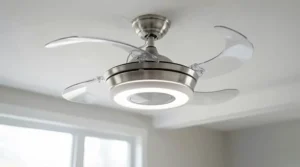
What is a fandelier? A fandelier is a single ceiling fixture that combines a decorative chandelier with a working fan motor. Its blades are hidden, retractable or styled to look like part of the design, so the fixture reads as a light first and an appliance second. It moves less air than a full-size fan but looks far more intentional.
A standard ceiling fan with light flips those priorities. The blade span is big, usually 42 to 60 inches, the motor is built around torque, and the light kit is an add-on. According to a Hunter Fan comparison of caged fans and fandeliers, the fandelier is the better choice when you want the fixture to be a centerpiece, and its compact blades are less noticeable.
The practical gap shows up in the numbers. One retailer comparison puts fandeliers at roughly 1,000 to 3,500 CFM with 1,500 to 4,000 lumens. Standard fans land around 4,000 to 6,500 CFM but usually put out under 1,600 lumens. Treat those as category ranges rather than guarantees, and always check the exact model’s spec sheet.
Here’s the plain-English version. A fandelier spends its budget on light and looks, and a standard fan spends it on blades and motor. Neither is cheating. They are just answering different questions.
Top 7 Fandelier and Standard Ceiling Fan Picks: Expert Analysis
| Pick | Size | Motor / Airflow (as listed) | Price Tier | Best For |
|---|---|---|---|---|
| SAMPHON 42-inch | 42″ | DC motor, app + remote | Mid-range | Smart living rooms |
| LEDIARY 42-inch | 42″ | Timer, dimmable, remote | Budget to mid | Bedrooms |
| addlon 20-inch | 20″ | Low profile, remote | Budget | Small rooms |
| Depuley 36W | 36″ | Retractable blades, remote | Budget to mid | All-rounders |
| Costway 52-inch | 52″ | 5 wooden blades | Budget to mid | Large rooms |
| DREO Smart | 52″ class | Listed near 5,673 CFM, ~22dB | Mid-range | Quiet smart homes |
| POCHFAN 52-inch | 52″ | Listed 5,200+ CFM max, ~30dB | Budget to mid | Low ceilings |
Notice how the airflow numbers jump once you cross into the 52-inch class. That is the whole argument of this article in one column, and the analysis below explains why it matters. The fandeliers publish less airflow data, which is itself a yellow flag worth noting. If a model won’t tell you its CFM, you’re buying on faith.
1. SAMPHON 42-inch Retractable Crystal Fandelier — smart controls with crystal drama
The standout feature is a package that pairs retractable blades with app and remote control. That combination is rare in the fandelier world, where basic remotes are the norm.
Listed specs include a DC motor, three-color-temperature dimming and app-plus-remote operation. In practice, a DC motor typically means quieter running and finer speed steps, which matters in a bedroom or living room where the fan runs for hours. The three color temperatures let you swing from warm evening glow to a cooler task light without swapping bulbs.
Based on the spec comparison, this is the pick for someone who wants a crystal centerpiece and modern controls in one fixture. The 42-inch span is large for a fandelier, so it suits a medium living room better than a closet-sized office. One thing the spec sheet won’t tell you is how it behaves in a steeply vaulted room, so check the slope rating before ordering.
Review roundups I could verify rate it as an editor’s choice in the category. Individual customer review counts weren’t verifiable, so treat that praise as directional.
Pros:
- ✅ Retractable blades hide neatly when off
- ✅ DC motor suggests quiet, efficient running
- ✅ App, remote and dimmable color temperatures
Cons:
- ❌ Crystal detailing collects dust over time
- ❌ Airflow trails true 52-inch fans
Price range: typically the mid-range tier of fandeliers, so check current price. Value verdict: fair if you’ll use the smart features, overpriced if you won’t.

2. LEDIARY 42-inch Retractable Chandelier Ceiling Fan — timer and dimming for bedrooms
The hook here is the feature list a bedroom actually needs. It offers a timer, dimming and three changeable color tones, all from the remote.
A timer sounds like a throwaway feature until you picture falling asleep under a fan that shuts itself off. That saves energy and avoids the 3 a.m. chill. Dimming plus color tones means one fixture covers reading light, nightlight and “dinner party” mood.
On the spec comparison, it looks like a sensible middle path. The 42-inch span gives it a better shot at moving air than the 20-inch minis, while the retractable design keeps the crystal look uncluttered when the fan is idle. Bedroom buyers who want a fandelier with remote control features, without paying for app integration, are the natural audience.
Roundup reviewers consistently list it among the top chandelier fans of the year. Treat the star ratings as secondary until you read the current buyer feedback yourself, since I couldn’t verify review volumes.
Pros:
- ✅ Timer function adds sleep-friendly convenience
- ✅ Three color tones and full dimming
- ✅ Retractable look keeps the ceiling tidy
Cons:
- ❌ Retractable mechanisms add moving parts to fail
- ❌ Published airflow data is thin
Price range: budget-to-mid, so check current price. Value verdict: strong for bedrooms, less convincing for large open rooms.
3. addlon 20-inch Crystal Fandelier — the budget way into the category
The standout is its size and cost, a compact crystal fixture that makes the fandelier idea affordable.
At 20 inches with a low-profile body, this model is about ambient air, not wind. It gently stirs the air above a dining nook or small bedroom, which is a real benefit when stuffiness is the enemy. It is not going to cool a sweaty summer afternoon in an open-plan space.
The honest take is that the small blade span caps its usefulness. The physics are unforgiving: a tiny fan has to spin hard to move meaningful air, and that tends to add noise. For a small room under about 100 square feet, though, the trade can be worthwhile. Where this model works best is as a light that happens to move air.
Roundup lists name it a best-value crystal fandelier. Real buyer sentiment will vary by room size, so match it to a small space and expect a gentle breeze.
Pros:
- ✅ Low-profile design suits modest ceilings
- ✅ Crystal styling at an entry-level cost
- ✅ Remote control included
Cons:
- ❌ Limited airflow for larger rooms
- ❌ Small blades can run louder at high speed
Price range: budget tier, so check current price. Value verdict: good for small rooms, a poor fit for anything bigger.
4. Depuley 36W Retractable Chandelier Ceiling Fan — the versatile middle ground
Its hook is flexibility, a retractable chandelier fan that BestReviews labeled “most versatile” in an older roundup.
A 36-inch span splits the difference between the cute 20-inch minis and the 42-inch statement pieces. The retractable blades fold away so the fixture reads as a chandelier in the off position. The 36W light output is modest, so plan on supplemental lighting in larger spaces.
Here’s how I’d read it: this is the compromise buyer’s compromise. It will not out-blow a 52-inch fan, and it will not out-sparkle a crystal showpiece, but it handles dining rooms and mid-size bedrooms without drama. If you can’t decide, this is the tiebreaker.
The roundup that praised it is dated, so check current buyer feedback before committing. Reviews for retractable fans in general often mention installation time and occasional blade-mechanism quirks, so budget patience for the assembly.
Pros:
- ✅ Mid-size 36-inch span suits many rooms
- ✅ Blades retract for a clean chandelier look
- ✅ Remote operation of fan and light
Cons:
- ❌ 36W light may need supplementing
- ❌ Older review praise, so verify current feedback
Price range: budget-to-mid, so check current price. Value verdict: solid for general use if you’re not chasing extremes.
5. Costway 52-Inch Classical Crystal Ceiling Fan — real blades, chandelier sparkle
The standout is a hybrid approach, a standard-size fan with five wooden blades wearing crystal styling.
At 52 inches, this is no mini fandelier. It trades the retractable trick for blade span and, so, for real air movement across a large room. That is the cleverest compromise in this roundup, because you keep a proper blade sweep and still get a decorative crystal fixture.
The catch, flagged in an older BestReviews roundup, is that installation can be difficult and time-consuming. Crystal fixtures usually mean fiddly assembly, so schedule a Saturday, not a lunch break. It suits large living rooms and master suites where you want the breeze and the bling.
Verified review material here is limited to that roundup, so I’d treat sentiment as mixed-positive and still unverified at scale.
Pros:
- ✅ Full-size blade span moves real air
- ✅ Crystal styling reads as chandelier-like
- ✅ Good fit for larger rooms
Cons:
- ❌ Installation can be long and fiddly
- ❌ Blades remain visible when off
Price range: budget-to-mid, so check current price. Value verdict: great for big rooms, if you can stomach the assembly.

6. DREO Smart Ceiling Fan with Lights — quiet, high-airflow smart control
The hook is the pairing of whisper-level noise and big airflow.
Roundup listings show about 5,673 CFM, around 22dB operation and Alexa and Google Home compatibility. In plain terms, that means a fan that can move a lot of air without the hum that wrecks sleep, and it responds to voice commands. That combination is what a standard fan does best and what most fandeliers can’t match.
The spec comparison makes the case clearly. If your priority is staying cool, this style of fan beats any fandelier on moving air. The look is cleaner and more modern than traditional, but it is unmistakably a fan, so it won’t fool anyone into thinking it’s a chandelier.
Roundup reviewers call it an overall smart pick. Look at current buyer reviews for long-term reliability of the smart features, which I couldn’t verify.
Pros:
- ✅ Very high listed airflow near 5,673 CFM
- ✅ Whisper-quiet operation around 22dB
- ✅ Alexa and Google Home support
Cons:
- ❌ Reads as a fan, not a chandelier
- ❌ Smart features depend on your Wi-Fi setup
Price range: typically budget-to-mid, so check current price. Value verdict: the best airflow-per-dollar logic on this list.
7. POCHFAN 52-Inch Flush Mount — big airflow for low ceilings
The standout is the strongest airflow story for rooms where headroom is tight.
Listed specs show roughly 5,200+ CFM at maximum, about 30dB noise, six speeds, a dimmable light with three color temperatures and a reversible motor. Flush mounting means the fan hugs the ceiling, which is the right call for 8-foot rooms. Reversibility matters because a fan that can push warm air back down in winter earns its place year-round.
Here’s what that means for you. If a fandelier won’t move enough air in your room and your ceilings are low, this style is the practical answer. It sits tight, the blades are long, and the light is serviceable rather than showy.
Roundup reviewers recommend it for low ceilings. Note that one roundup flagged a much lower airflow figure for a different model, so confirm you’re reading the spec sheet for the exact variant you’re buying.
Pros:
- ✅ Strong listed airflow in a low-profile body
- ✅ Six speeds plus reversible motor
- ✅ Dimmable light with three color temperatures
Cons:
- ❌ Plain look next to chandelier-style fans
- ❌ Light is functional, not decorative
Price range: budget-to-mid, so check current price. Value verdict: excellent function per dollar, minimal glamour.
Real-World Scenarios: Matching Fixtures to Real Rooms
Specs are abstract, so here are three buyer profiles to make the choice concrete.
The 400-square-foot open-plan living room. You have a high ceiling, a sofa that gets afternoon sun and guests who complain about the heat. This room needs volume, and a fandelier’s published range of roughly 1,000 to 3,500 CFM won’t cut it alone. A fan in the DREO or POCHFAN class handles the air, and you can add dramatic pendants for the glamour. If you insist on a fandelier, the 42-inch SAMPHON is the most credible, but treat it as supplemental.
The 12-by-12 primary bedroom. At 144 square feet, you need gentle, quiet air and a soft light you can dim at night. A 42-inch fandelier like the LEDIARY fits, because a bedroom rarely needs gale-force airflow. A reasonable target is about 20 CFM per square foot, which here means roughly 2,900 CFM.
The dining nook. You want the fixture to look expensive and to take the edge off a stuffy room during dinner. The addlon or Depuley fandelier handles that job and avoids the “airport terminal” look of a big-bladed fan above your table.
The pattern is simple. The more the room is about performance, the more a standard fan wins. The more it is about presence, the more a fandelier does.

How to Choose Between a Fandelier and a Standard Ceiling Fan with Light
Follow these seven steps and you’ll land on the right fixture.
- Measure your room. Square footage drives airflow needs. Multiply by about 20 for a rough CFM target. A 140-square-foot bedroom needs roughly 2,800 CFM.
- Check ceiling height. The U.S. Department of Energy recommends fans for rooms with ceilings of 8 feet or more, per the University of Florida IFAS Extension guide on ceiling fans. Below that, look at flush mounts.
- Decide your priority. If cooling is the job, choose a standard fan. If the fixture is the room’s centerpiece, shortlist fandeliers.
- Demand published CFM. A model that hides its airflow is a risk. Real numbers let you compare apples to apples.
- Look at noise. DC motors tend to run quieter, which matters for bedrooms.
- Match the controls. Remote, app and timer features change daily life more than finish colors do.
- Plan the light. A fandelier’s integrated light can replace a chandelier, but a standard fan’s light kit usually can’t.
Run this checklist before you fall for a gorgeous photo. The photo can’t tell you how much air the fan actually moves.
Airflow Versus Aesthetics: The Real Trade-Off
This is the core of the whole decision. A ceiling fan is a physics problem wearing a decorative hat. Blade span, pitch, motor torque and speed decide how much air moves. A fandelier shrinks or hides the blades for looks, which cuts into every one of those.
The efficiency numbers add another layer. ENERGY STAR measures airflow per watt, and per the IFAS guide, certified fans must deliver at least 1,250 CFM at low speed with 155 CFM per watt. They must hit 3,000 CFM at medium and 5,000 CFM at high. Most fandeliers don’t publish the same data, so you can’t verify they would pass.
That doesn’t make them bad. It makes them honest about their purpose. For airflow versus aesthetics, a simple rule applies: if you’d be happy with a gentle breeze and a stunning ceiling, pick the fandelier. If you’d rather feel a real draft and tolerate a plain-looking fan, pick the standard fan.
There’s a middle road too. Crystal-style fans with full blade spans, like the Costway, aim for both, at the cost of installation effort. Know which side of the trade you’re on, and the shopping gets easy.
Fandelier vs Standard Ceiling Fan with Light: Head-to-Head Comparison
| Feature | Fandelier | Standard Fan with Light | Chandelier + Separate Fan |
|---|---|---|---|
| Airflow (typical CFM) | ~1,000 to 3,500 | ~4,000 to 6,500 | Depends on fan |
| Light output | Higher, decorative | Lower, utilitarian | Highest |
| Visual impact | Statement piece | Functional | Statement, but cluttered |
| Ceiling footprint | One fixture | One fixture | Two fixtures |
| Best For | Dining, bedrooms | Living rooms, great rooms | Large formal spaces |
Figures reflect category ranges from retailer comparisons, not model-specific guarantees. The table makes the trade obvious. The fandelier wins on looks and ceiling tidiness, while the standard fan wins on air. The two-fixture route wins on lighting but costs you wiring and visual clutter.
In a head-to-head on a hot day, the standard fan should win in most rooms. In a head-to-head on a dinner party night, the fandelier does. The takeaway: choose based on which situation you live in most.
Fandelier Ceiling Fan for Vaulted Ceilings: What Actually Works
A fandelier ceiling fan for vaulted ceilings looks magnificent when it works, and falls flat when it doesn’t. The key is the downrod, because a fan stuck high in a cathedral ceiling moves air nobody can feel.
A common rule of thumb says the bottom of the blades should sit roughly 7 to 9 feet above the floor. On a vaulted ceiling, that usually means a long downrod. Hunter’s downrod sizing guide notes that rooms with vaulted ceilings benefit most from a longer rod, and steeper slopes may need an angled ceiling mount.
For sloped ceilings, one calculator uses the formula (fan radius × rise/run) + 4 to estimate minimum downrod length. Check your fixture’s slope rating before buying, since some retractable models only handle slopes up to about 15 degrees. One retailer listing for a 36-inch retractable fandelier cites this limit explicitly.
The honest warning is that a small fandelier in a tall room will look lost and move little air. If you love the look, size up to a 42-inch model and extend the rod. If airflow is the point, a larger standard fan is the safer bet.
Fandelier with Remote Control for Living Room: Control Is Half the Experience
A fandelier with remote control for living room use makes a real difference, because living rooms are where you adjust things constantly. Brighter for the game, dimmer for the movie, cooler for guests. A wall switch makes you walk across the room each time.
Look for separate control of fan and light. One retailer listing for a 36-inch retractable fandelier highlights exactly that, with the remote adjusting fan speed and light independently. That sounds minor, but it matters when you want light without wind.
App control adds scheduling, and voice assistants add hands-free changes. The SAMPHON and DREO both advertise this. Remember that smart features depend on your Wi-Fi, so buy them only if you’ll use them.
For a living room, the sweet spot is a 42-inch fandelier paired with a dimmer and color-temperature settings, or a standard fan with a quiet DC motor. The remote often matters more than the finish, so judge it as seriously as the fixture itself.
Retractable Blades: Clever Engineering or Gimmick?
Retractable blades are the fandelier’s signature trick. They fold into the housing when off, so the fixture looks like a chandelier. When on, they extend and spin. One retailer notes they conceal automatically above the light kit when the fan is switched off.
The upside is obvious: a clean look and fewer dust-covered blades. One reviewer-style listing cites reduced dust as a feature. The downside is mechanical. More moving parts mean more places for something to fail, and blade-extending motors add complexity.
There’s also a functional caveat. One buying guide noted that its retractable pick couldn’t reverse the motor, which matters if you want winter air circulation. Another listing for a 42-inch retractable model claims reversibility, so specs vary and you should read each one.
Verdict: retractable blades are real engineering, not just marketing, but they carry trade-offs. They suit people who rank looks highly and use the fan moderately. If you run a fan eight hours a day, simple fixed blades will likely outlast them.

Shaded Light Fixture Design: Why the Lighting Matters as Much as the Fan
A shaded light fixture changes how a room feels more than most people expect. Shades soften glare, shape the light and hide bare bulbs. Fandeliers lean on this heavily, with crystal, cage and fabric-style shades doing the decorative work.
Lumens are the number to watch. Retailer comparisons put fandeliers at roughly 1,500 to 4,000 lumens versus under 1,600 for most standard fans. That gap is why a fandelier can replace a chandelier and a standard fan usually can’t.
Color temperature matters too. Fixtures offering 3000K, 4000K and 6000K settings, like some Lowe’s-listed retractable models, let you move from cozy to crisp. Dimming is essential, because a shaded fixture that’s too bright defeats its own purpose.
A practical tip: shaded designs can trap dust and reduce usable light if shades are dense. Check bulb access and cleaning ease before buying. A beautiful shade is no bargain if changing a bulb takes a ladder and a prayer.
Features That Actually Matter (And Those That Don’t)
Features worth paying for:
- 🔊 A DC motor. One source says DC motors are about 70 percent more efficient than AC and typically run quieter.
- ⚡ Published CFM and watts. Without them, comparison is guesswork.
- 🎛️ Separate fan and light control. It matters more than you’d think.
- 🌡️ Color-temperature settings. You’ll use them daily.
Features that are mostly hype:
- ✨ Crystal count. More crystals means more dust, not better performance.
- 📱 App control you won’t open. Remotes handle most daily needs.
- 🏆 “Patented design” claims. Interesting, but not a performance guarantee.
The rule of thumb: pay for what you’ll touch every day and ignore what only looks good in the listing photo. A fixture’s spec sheet tells you far more than its marketing copy.
Common Mistakes When Buying a Fandelier or Ceiling Fan
Sizing a fandelier like a chandelier. The fan still needs air to move through, so go larger for rooms above 150 square feet.
Ignoring ceiling slope. Retractable models often cap at about 15 degrees. A steeper ceiling needs a different mount.
Skipping the downrod math. A fan hugging a high ceiling circulates air nobody feels.
Trusting the lumen number alone. Brightness without dimming leaves you with a glare machine.
Buying without CFM. If a listing won’t publish airflow, treat that as a warning sign.
Underestimating assembly. Crystal fixtures can take hours. One roundup flagged the Costway crystal fan as time-consuming to install.
Forgetting winter. Some retractable models can’t reverse, so check if you want seasonal use.
Avoid these and you dodge most of the regrets that show up in buyer feedback.
Long-Term Cost and Maintenance: What Each Option Really Costs
| Cost Factor | Fandelier | Standard Fan with Light |
|---|---|---|
| Upfront price tier | Budget to premium | Budget to mid |
| Energy use | Often unpublished | Labeled by CFM/watt |
| Maintenance | Dusting crystals, mechanism checks | Dusting blades |
| Best For | Style-first buyers | Performance-first buyers |
Energy matters more than you’d think. As Green Building Advisor’s guide to energy-efficient ceiling fans explains, fans now carry labels showing airflow per watt, and efficiency varies widely between models. A fan that moves more air per watt costs less to run.
Fandeliers rarely publish that data, so total cost of ownership is harder to estimate. Maintenance adds up too. Crystals need dusting, and retractable mechanisms may need checking. Standard fans are simpler, with a wipe of the blades every few months.
The analysis is simple. A standard fan costs less to own and is easier to verify. A fandelier costs more in attention but pays back in appearance. If you value the look, the premium can be worth it. If you want the lowest running cost, the standard fan wins.
✨ Don’t Miss These Exclusive Deals!
🔍 Take your ceiling to the next level with these carefully selected fixtures. Click on any highlighted product to check current pricing and availability. These picks will help you create the room you’ve been picturing!
Practical Usage Guide: Setup and First-30-Day Tips
Getting the most from either fixture comes down to setup and habits.
Setup. Turn off power at the breaker, confirm the electrical box is rated for a fan, and use the downrod that matches your ceiling. Read the manual, because retractable models have specific assembly sequences. Crystal fixtures take longer, so lay out parts first.
First use. Run the fan on low for a few minutes and check for wobble. Test the remote for both fan and light. On retractable models, confirm the blades extend and retract smoothly.
Maintenance schedule. Dust blades or crystals monthly. Check screws every few months, since vibration loosens hardware. For retractable fans, watch the mechanism for hesitation.
Seasonal tricks. If your motor reverses, run the fan on low in winter to push warm air down. If it doesn’t, simply switch the fan off in cold months.
Common 30-day mistakes. Mounting too high, ignoring wobble, and leaving the remote’s batteries until they die mid-party. A small routine saves a lot of annoyance, and none of it appears on the Amazon listing.

Frequently Asked Questions
❓ Is a fandelier worth it compared to a regular ceiling fan?
❓ Can a fandelier be installed on a sloped ceiling?
❓ Are fandeliers noisy compared with standard fans?
❓ How many lumens does a fandelier produce?
❓ Can I control a fandelier with my phone or voice?
Conclusion: Pick Your Priority, Then Pick Your Fixture
The fandelier vs standard ceiling fan with light question has a clean answer once you name your priority. If the fixture needs to look like a chandelier and the room is small to medium, a fandelier like the SAMPHON, LEDIARY or Depuley is a smart fit. If budget matters most, the addlon gets you in the door.
If you need real airflow, especially in large rooms or low-ceiling spaces, a standard fan like the DREO or POCHFAN moves far more air. The Costway crystal fan sits in the middle for people who want blades and sparkle together.
The main lesson of airflow versus aesthetics is that you rarely get both at full strength. Know which one you’re buying, check the published CFM, size the downrod and match the controls to how you live. Do that and the fixture will earn its spot on your ceiling.
Recommended for You
- [Add your blog post link 1]
- [Add your blog post link 2]
- [Add your blog post link 3]
Disclaimer: This article contains affiliate links. As an Amazon Associate, I earn from qualifying purchases. If you purchase products through these links, we may earn a small commission at no additional cost to you.
✨ Found this helpful? Share it with your friends! 💬🤗
